What is Islamic Inheritance (Mirath)
Islamic Inheritance, known as Mirath (الميراث) or Faraid (الفرائض), is the system in Islam that explains how a deceased person’s wealth and property should be distributed among their relatives. These rules are clearly defined in the Qur’an and explained by the teachings of the Prophet Muhammad ﷺ.
The main guidance for inheritance comes from the Qur’an, especially in Surah An-Nisa (verses 11, 12, and 176). These verses describe the shares for family members such as parents, spouses, children, and siblings.
World-Class Mirath Calculator
How the Islamic Inheritance Calculator Works
An Islamic Inheritance Calculator is a tool that helps Muslims estimate how a deceased person’s wealth should be distributed under Islamic law. These rules come from the Qur’an and the teachings of Prophet Muhammad ﷺ, mainly explained in Surah An-Nisa.
The calculator follows the same step-by-step process used in Islamic inheritance law (Faraid).
1. Enter the Total Estate Value
First, the user enters the estate’s total value.
This may include:
- Money in bank accounts
- Property or land value
- Gold and other assets
- Business value
- Investments
The calculator uses this total amount to start the inheritance calculation.
2. Deduct Funeral Expenses and Debts
According to Islamic law, the estate cannot be distributed immediately. Certain obligations must be paid first.
The calculator subtracts:
- Funeral and burial expenses
- Any unpaid debts of the deceased
Only the remaining amount is considered for inheritance distribution.
3. Apply the Wasiyyah (Will)
Islam allows a person to leave a will (Wasiyyah) for charity or non-heirs.
Important rule:
- The will cannot exceed one-third of the estate.
If a user enters a higher amount, the calculator automatically adjusts it to the maximum allowed limit.
4. Identify the Heirs
Next, the user selects which family members are alive.
Common heirs include:
- Husband or wife
- Father and mother
- Sons and daughters
- Brothers and sisters
- Grandparents
The calculator identifies eligible heirs and also applies blocking rules (some heirs cannot inherit if closer relatives exist).
Example:
- If a son is alive, brothers usually do not inherit.
5. Calculate Fixed Shares (Faraid)
Islamic inheritance law assigns fixed shares to certain heirs.
For example:
- Wife receives 1/8 if the deceased has children
- Husband receives 1/4 if the deceased has children
- Mother usually receives 1/6 when children exist
The calculator automatically assigns these shares according to Islamic rules.
6. Distribute the Remaining Estate
After fixed shares are given, the remaining estate is distributed among children using the rule:
A son receives twice the share of a daughter.
Example:
If there is:
- 1 son
- 1 daughter
The inheritance is divided into three parts:
- Son receives two parts
- Daughter receives one part
7. Show the Final Results
The calculator displays the results in a clear format:
- Each heir’s share
- Percentage of inheritance
- Exact monetary value
Many advanced calculators also show:
- Pie chart distribution
- Step-by-step explanation
- Downloadable inheritance report
Important Note
An inheritance calculator provides an estimate based on general rules of Islamic law. Complex cases may involve additional factors such as:
- Multiple generations of heirs
- Missing relatives
- Special legal conditions
For such situations, it is recommended to consult a qualified Islamic scholar or a Faraid expert.
Why Islamic Inheritance Is Important
Islamic inheritance laws ensure that wealth is distributed fairly and justly among family members. Instead of leaving everything to one person, Islam assigns specific shares to eligible heirs.
This system helps to:
- Prevent family disputes after death
- Protect the rights of women and children
- Ensure fair wealth distribution
- Follow the commands of Allah
Qur’an Verses About Inheritance
Islamic inheritance laws are clearly explained in the Qur’an, mainly in Surah An-Nisa. These verses describe how wealth should be distributed among family members after a person passes away.
Below are the most important Qur’anic verses about inheritance.
1. Verse About Children and Parents
Surah An-Nisa 4:11
Arabic
يُوصِيكُمُ ٱللَّهُ فِىٓ أَوْلَـٰدِكُمْ ۖ لِلذَّكَرِ مِثْلُ حَظِّ ٱلْأُنثَيَيْنِ
English Meaning
Allah commands you regarding your children: for the male is the share of two females. If there are only daughters, two or more, they receive two-thirds of the inheritance. If there is only one daughter, she receives half. Parents also receive shares depending on whether the deceased had children.
Explanation
This verse explains:
- Sons receive double the share of daughters
- A single daughter receives half
- Two or more daughters receive two-thirds
- Parents receive fixed shares
2. Verse About Spouses
Surah An-Nisa 4:12
Arabic
وَلَكُمْ نِصْفُ مَا تَرَكَ أَزْوَٰجُكُمْ إِن لَّمْ يَكُن لَّهُنَّ وَلَدٌ
English Meaning
You (husbands) receive half of what your wives leave if they have no children. If they have children, you receive one-fourth.
Similarly, wives receive one-fourth if the husband has no children, and one-eighth if he has children.
Explanation
This verse explains:
- Husband receives 1/2 if wife has no children
- Husband receives 1/4 if children exist
- Wife receives 1/4 if husband has no children
- Wife receives 1/8 if children exist
3. Verse About Siblings
Surah An-Nisa 4:176
Arabic
يَسْتَفْتُونَكَ قُلِ ٱللَّهُ يُفْتِيكُمْ فِى ٱلْكَلَـٰلَةِ
English Meaning
They ask you for a ruling. Say: Allah gives you a ruling concerning one who dies leaving no parents and no children. If a man dies and leaves a sister, she receives half of his estate. If there are two sisters, they receive two-thirds.
Explanation
This verse explains inheritance when:
- The deceased has no parents or children
- Siblings become the heirs
4. Verse About Justice in Distribution
Surah An-Nisa 4:7
Arabic
لِّلرِّجَالِ نَصِيبٌ مِّمَّا تَرَكَ ٱلْوَٰلِدَانِ وَٱلْأَقْرَبُونَ
English Meaning
For men is a share of what parents and relatives leave, and for women is a share of what parents and relatives leave, whether it is little or much.
Explanation
This verse establishes an important principle:
✔ Both men and women have rights to inheritance.
Before Islam, women often did not receive inheritance. This verse established fairness in wealth distribution.
Summary of Main Qur’an Inheritance Verses
| Verse | Topic |
|---|---|
| Surah An-Nisa 4:7 | Right of men and women to inherit |
| Surah An-Nisa 4:11 | Shares of children and parents |
| Surah An-Nisa 4:12 | Shares of spouses |
| Surah An-Nisa 4:176 | The right of men and women to inherit |
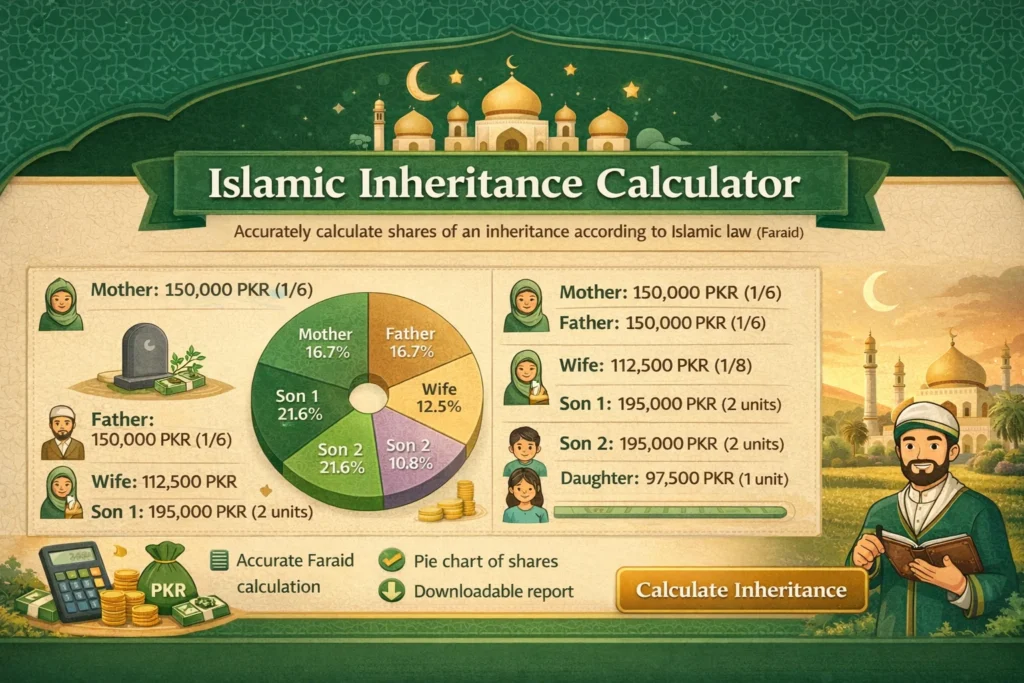
Example Calculation of Islamic Inheritance (Mirath)
Let’s take a practical example to see how a modern Islamic inheritance calculator works. This example uses common Sunni Faraid rules.
Inheritance Distribution
Frequently Asked Questions, Islamic Inheritance Calculator
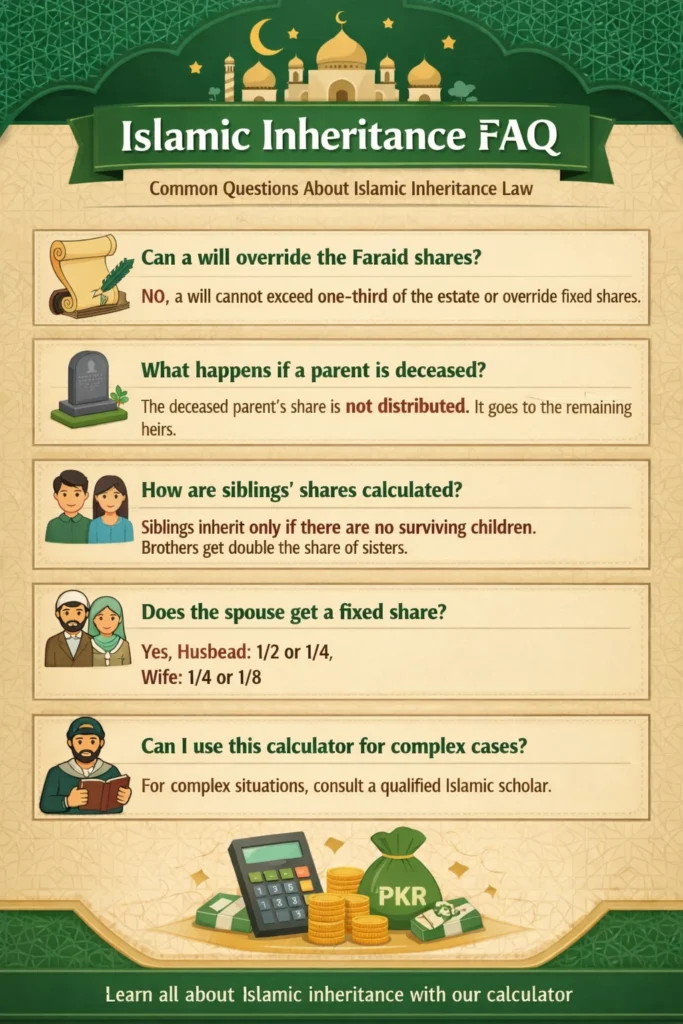
Q1: Can a will override the Faraid shares?
A: No. In Islam, a will (Wasiyyah) cannot exceed one-third of the estate and cannot override the fixed shares assigned to heirs. Fixed Faraid rules must always be followed.
Q2: What happens if a parent is deceased?
A: If a parent is deceased, their share is not distributed. The remaining estate is distributed among the other heirs according to Faraid rules.
Q3: How are siblings’ shares calculated?
A: Siblings inherit only if there are no surviving children. Brothers receive double the share of sisters. If children exist, siblings may be blocked from inheritance.
Q4: Does the spouse get a fixed share?
A: Yes. The spouse receives:
Husband: 1/2 if no children, 1/4 if children exist
Wife: 1/4 if no children, 1/8 if children exist
Q5: Can I use this calculator for complex inheritance cases?
A: The calculator covers most common cases. For complex situations (multiple generations, missing heirs, unusual family structures), it is recommended to consult a qualified Islamic scholar.
Conclusion
The Islamic Inheritance system in Islam is a divine law designed to ensure justice and balance in society. These rules were revealed in the Qur’an and explained through the teachings of the Prophet Muhammad ﷺ. By following these guidelines, Muslims distribute wealth fairly and prevent family disputes.
